The report at a glance
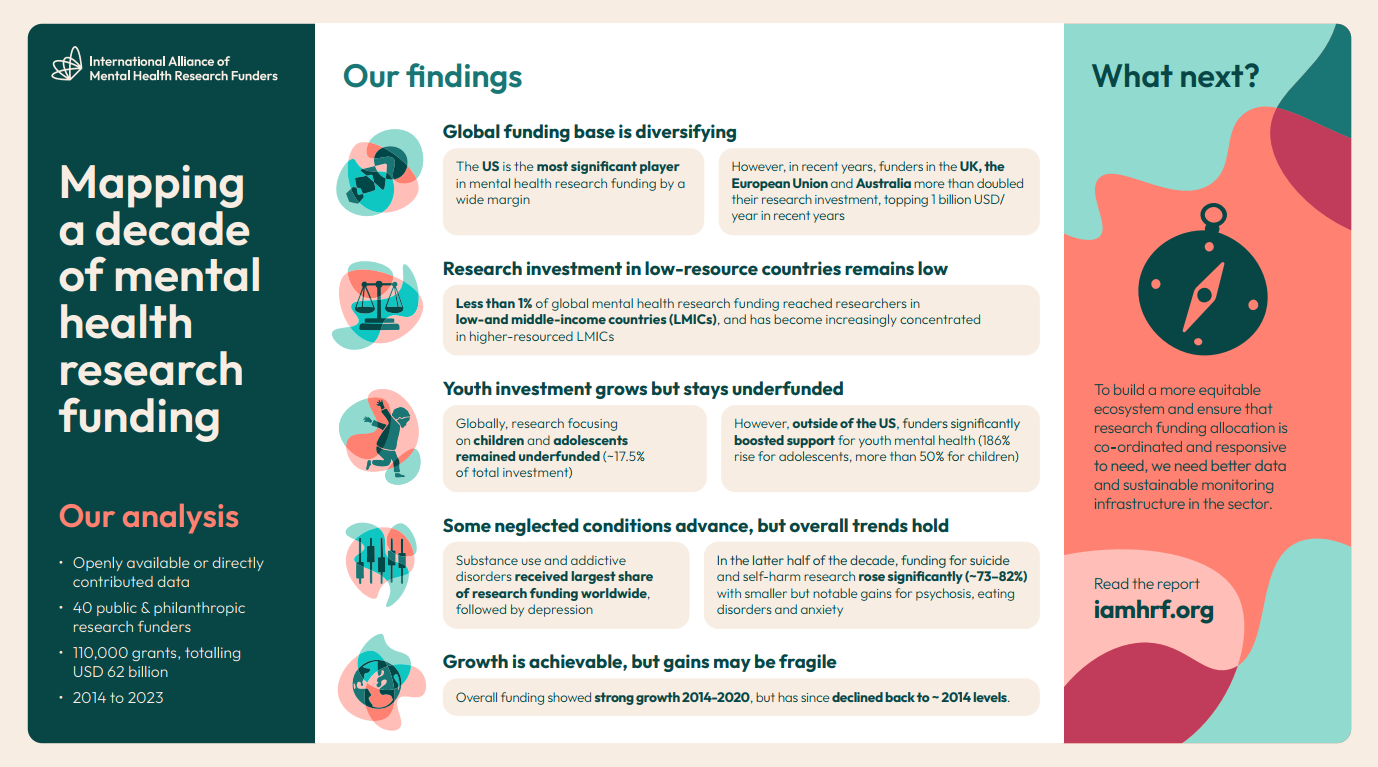
The International Alliance of Mental Health Research Funders (IAMHRF) conducted a mental health research funding analysis of around 110,000 grants from 40 public and philanthropic funders. It is the most comprehensive update since our 2020 report and offers a full decade of trend data (2014-2023).
A decade of transition has broadened the field’s funding base and begun to direct resources towards some long-neglected conditions. At the same time, a post-2020 contraction, the stalling of support for research based in low- and middle-income countries (LMICs), and the continuing underinvestment in young people’s mental health, reminds us how fragile this progress is.
This report presents momentum to accelerate change with better coordination and shared intelligence. By drawing on successful examples from other health domains, we can work towards making the distribution of mental health research funding more visible and actionable through a shared intelligence monitor.
Why this study
Mental health conditions account for a growing share of global disease burden, and mental health research has historically been underfunded relative to this need. But the absence of ongoing monitoring of mental health research funding leaves funders and policymakers with limited information to steer investment.
In response, we carried out an open, grant-level analysis of mental health research investments over a decade. Combining openly available and directly contributed grant data from 40 public and philanthropic research funders, we mapped trends in funding from grants awarded between 2014 and 2023.
What we found
Overall funding shows significant growth followed by recent decline
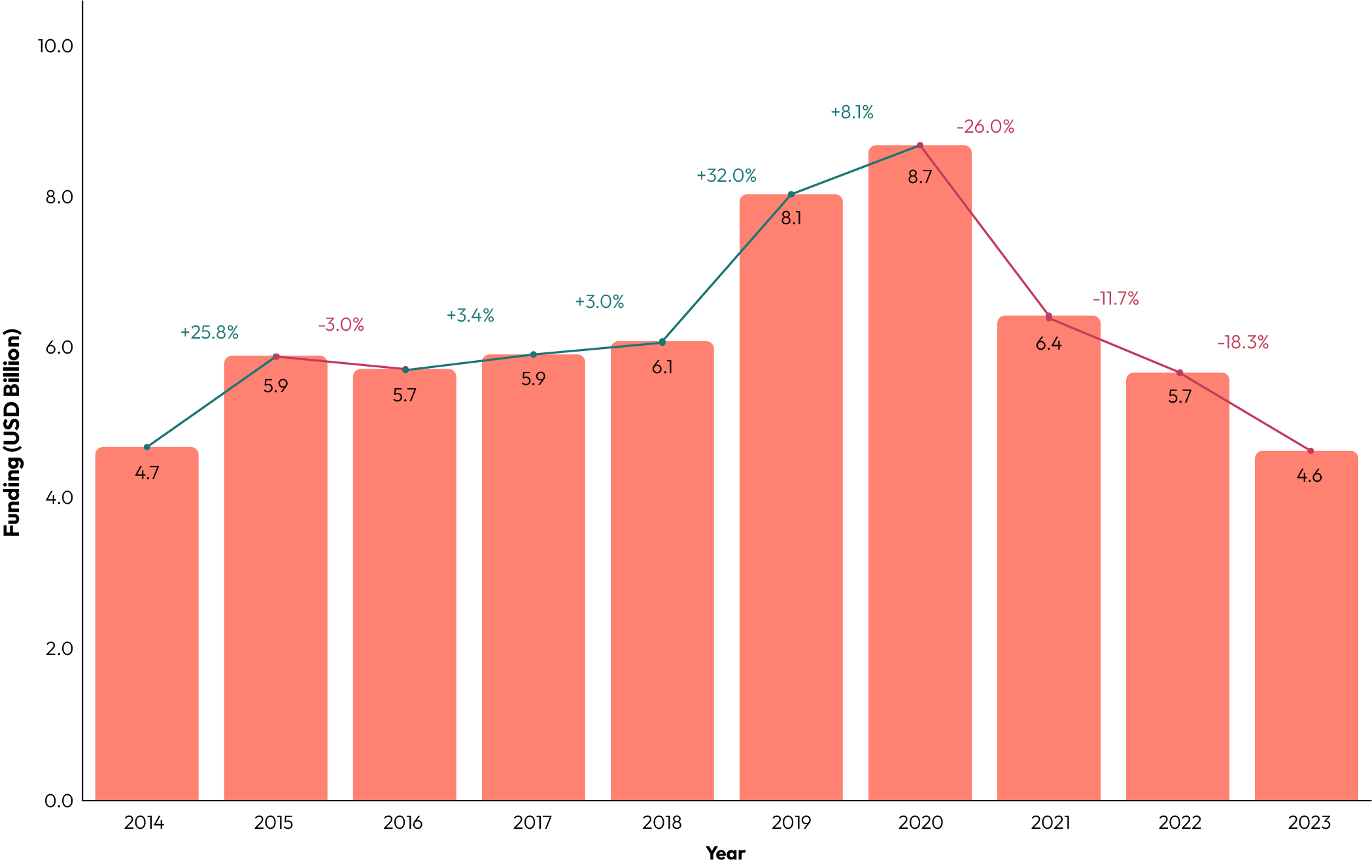
After nearly doubling from 2014 to 2020, global mental health research expenditure has begun declining such that, by 2023, it looked to be on par with its 2014 level in real terms. Importantly, this post-2020 contraction looks steeper than trends in overall health R&D, raising concerns about the field’s resilience in the wake of COVID-19.
There are positive signals of diversification
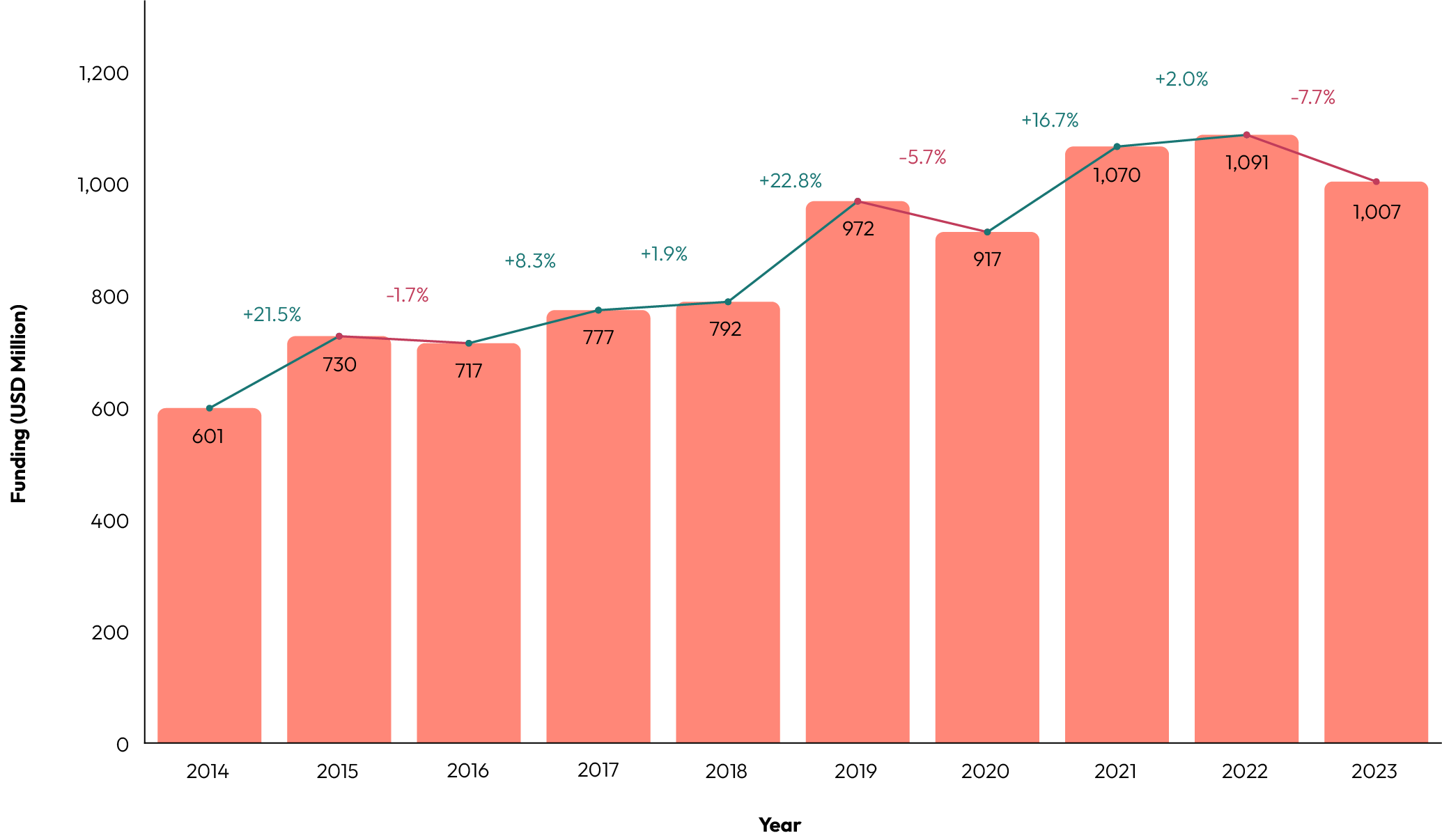
In contrast to the global trend, funders outside the US displayed sustained and significant growth over time, investing over USD 1 billion annually in recent years. Notably, mental health research investment in the UK, the European Union and Australia close to doubled in the latter half of the decade.
Investment in low- and middle-income countries remains critically low
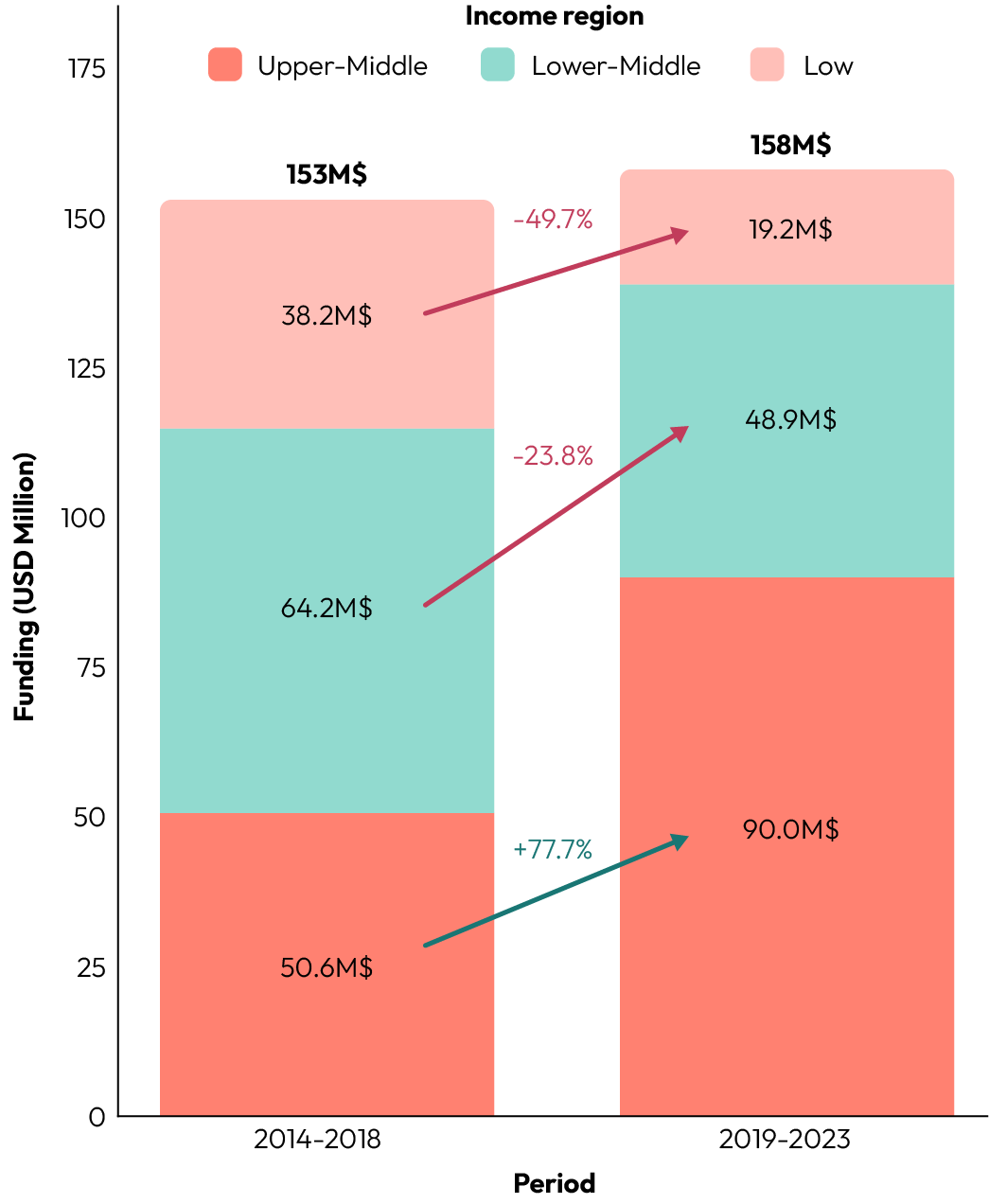
When comparing 2019–2023 to 2014–2018, funding for researchers in LMICs remained flat and was increasingly concentrated in higher-resource LMICs.
Young people’s mental health research remains underrepresented globally
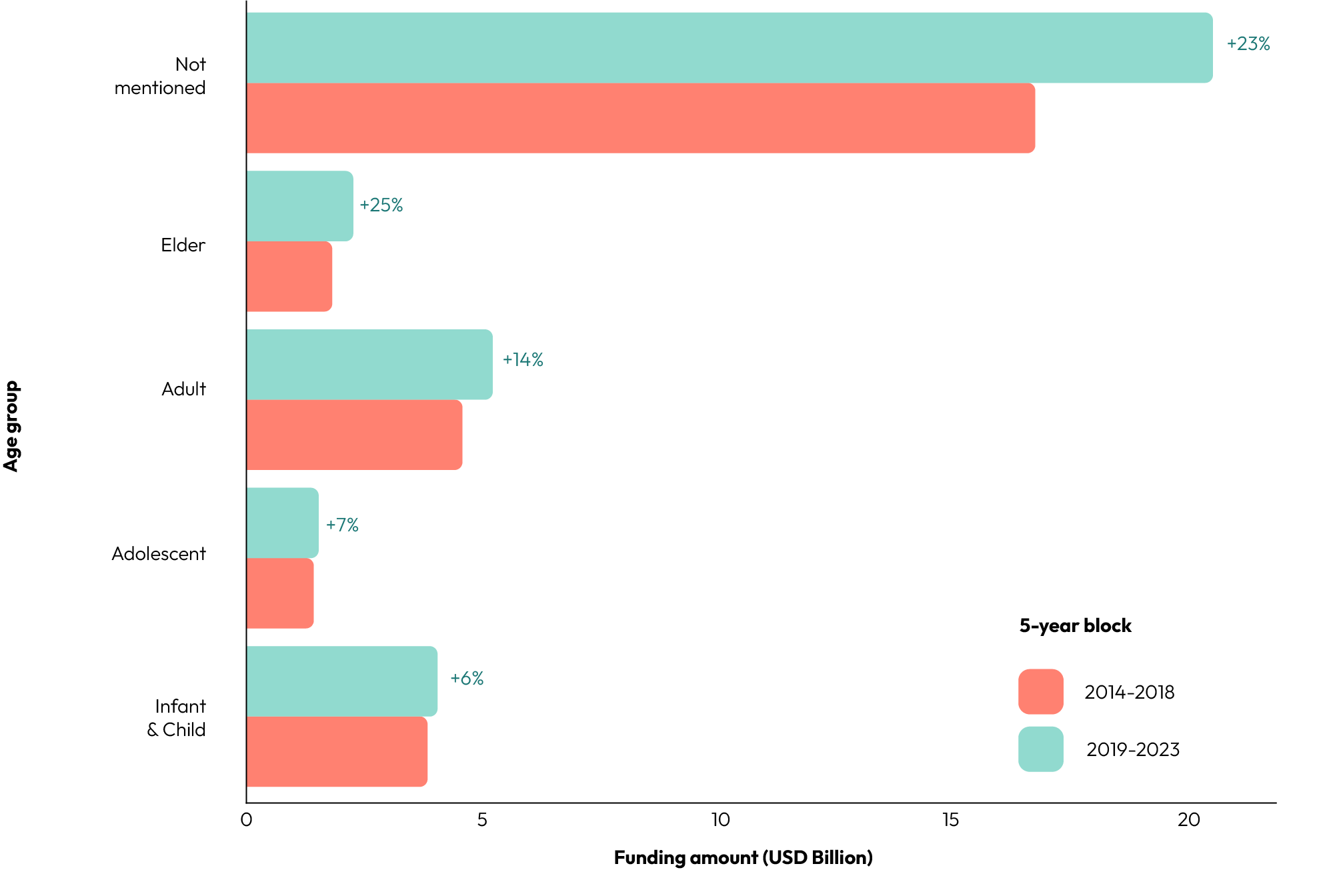
Only ~17.5% of identified mental health research funding was directed toward child or adolescent mental health, despite this being a period of greatest vulnerability.
Encouragingly, non-US funders substantially boosted support with a trebling of funding for adolescent-focused research, and more than 50% increase for child-focused work, in the more recent period.
Funding priorities are beginning to shift toward historically overlooked conditions
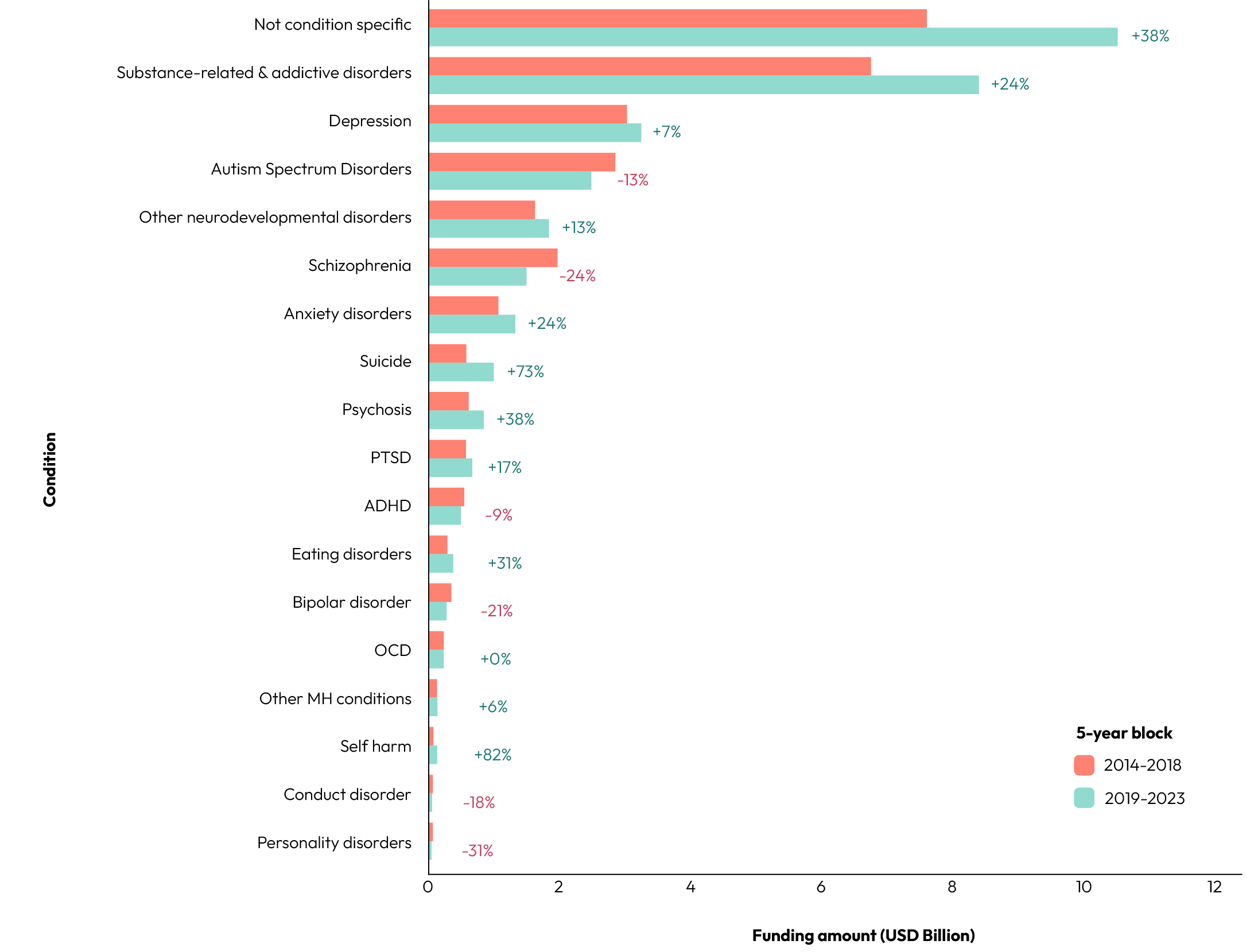
Substance use and addictive disorders received the largest share of research funding globally, followed by depression. Importantly, some areas previously identified as neglected showed notable growth in the latter half of the decade: funding for suicide and self-harm research rose by~73–82%, and sizeable (~30%) increases were also seen for psychosis, eating disorders, and anxiety.
The foundation for a data sharing infrastructure
One of the central questions this study surfaces is whether periodic analyses like ours are sufficient to support the field’s decision-making, or whether a more sustained approach is needed. That is ultimately a judgement for the sector to make.
However, by looking at comparable initiatives in other fields including International Cancer Research Partnership (ICRP) and Pandemic Preparedness Analytical Capacity and Funding Tracking Programme (Pandemic PACT), we see that these trackers have enabled impact and influence that periodic reporting cannot match.
Without shared intelligence in mental health, duplication is likely to sit alongside gaps no one sees, and the geographic, condition, and age-related inequities documented here may persist despite growth in headline spend.
With substantial new investments in mental health, we have an opportunity to come together around a shared map of the sector so that funding achieves the greatest possible impact on people’s lives.
How might we design a mental health research funding monitor? Tell is in less than two minutes:
Get involved
Help shape what comes next
Spread the word
- Amplify this report using our dissemination toolkit (includes social media copy and visuals, including infographic)
Learn more
- Mental health research funding: from snapshot to shared infrastructure: Read The Lancet Psychiatry Comment by our Executive Director Raliza Stoyanova
- Read the full report:
This work was conducted independently by IAMHRF and does not represent the views of any individual funder or partner organisation.