IAMHRF Member News Roundup: first quarter of 2026
Highlights from across the Alliance From new investments in research participation to fresh evidence on youth mental health and innovative ways…
Read article
Too often, research produces interventions that are difficult to scale. This is frustrating for researchers, funders, and critically, those poised to benefit from these interventions. So, how can we bridge the implementation gap?
The Lancet Psychiatry Commission on Transforming Mental Health Implementation Research challenged mental health research and implementation communities to close the gap, and to support this sector discussion we partnered with the team on a series of symposia. Our aim was to bring the issues and opportunities to life, stimulate discussion and reflection, and explore where there is resonance for action.
Over the course of the past year, we looked at how systems thinking can transform implementation, why the evidence we generate isn’t always the evidence we need – and how all of this (and more) comes together in decision-making.
Time and time again, the message was clear: people are at the heart of the system. From a person-centred perspective, it seems like the natural state of the research and implementation system should be to understand problems together, have access to a varied toolkit for evidence generation to probe problems and generate meaningful solutions, and make recommendations to funders and investors about where best to place their limited resources to help create healthier and happier people and communities. When this does happen – and it does – we start to close the implementation gap.
Firstly, we hold strong assumptions about what makes for ‘good’ evidence – to the detriment of other forms of evidence and ways of knowing. Speakers discussed that evidence too often means ‘quantitative data generated by experts’, invalidating important sources (such as from people with lived experience) and types of evidence (such as systematic qualitative approaches). Incentives, rewards and funding can too often follow this thinking – and don’t always create space for integrating values, preferences and context alongside data. If the evidence generation system is skewed from the get-go, we miss out on a lot. The panel concluded that a hierarchy of evidence is not helpful when it pits one form of evidence against another – it’s only useful in terms of describing the type of evidence that is needed to answer a particular research question. It’s good to be rigorous, but not to be myopic. In an ideal world, we should start with the research question and then select the right combination of methods. This is easy to say, but harder to do!
Second, the system isn’t set up to generate evidence in an integrated way overall – it generally supports siloed thinking. Where integration works well (such as Youth Wellness Hubs Ontario), proactive efforts have been made to embed a collaborative, cross-disciplinary learning culture – thinking about values, influential leadership and supportive governance. We need to create spaces that break down silos and build networks between researchers, implementers, contexts and regions.
Finally, we don’t always understand the needs of people who are making decisions about evidence and how to communicate with them. It can be too easy to take an approach that says ‘generate the evidence and they will come!’ – but in reality, decision-makers have competing demands and pressures. And they are people too! Through the Friendship Bench project, we heard from how finding the right champion can really move the dial on decision-making – and how stories and connecting with impact can open the door, so the numbers can keep it open. Stories help decision-makers understand what numbers mean for people’s lives and reduce stigma by inspiring hope and possibility – and they have the greatest impact when told in people’s own words, when those people are present in the rooms where policy is shaped. We heard that implementation and system reform is never a one-off event; it’s built through years of shared effort and shared strategy. Our panel discussed that progress depends on embracing the messiness of scale-up as part of learning, not failure. To do this, implementation and research need to meet in the middle – rigour and reality learning together.
Speakers had many ideas. For example:
It has been inspiring to look at the challenges through the lens of examples that buck the trend – examples that show us what is possible and give us ground to build on.
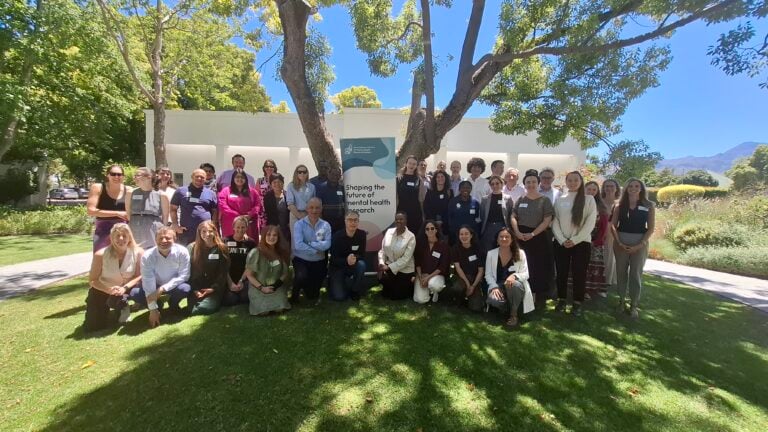
This series has helped shape how we at IAMHRF think about the impact of mental health research, and the conditions that are needed to create it. This has already guided us to use a systems-informed approach to designing our recent in-person meeting in Cape Town.
Creating impact through mental health research and implementation feels like a jazz band uniting rhythm and skill. This arises from players’ individual skill and flexibility, knowing each other, and knowing when to lead and when to follow – so coherence can emerge from true partnership. Our ongoing work focuses on areas where there is a real need to build such coherence – whether that is in funder practice on lived experience, helping connect understanding and functionality across the measurement system, or identifying those sticky areas where sector discussions are needed – will be informed by this principle.
We encourage you to watch the full series, and continue to let us know your thoughts. Thank you to our incredible speakers, chairs and partners!
*This series was run in collaboration with The Lancet Psychiatry and two of our members: Grand Challenges Canada and Wellcome.
Symposium 1: Systems matter
Symposium 2: What do we mean by evidence?
Symposium 3: Hearts and Minds
Highlights from across the Alliance From new investments in research participation to fresh evidence on youth mental health and innovative ways…
Read articleReflections from the International Alliance of Mental Health Research Funders The impact of cuts to care and research have been a source…
Read articleExplore some of what our members achieved in 2025 Overview Browse through the success stories below and spread the word…
Read articleFrom 12–14 November 2025, IAMHRF brought together around 40 delegates in Cape Town, South Africa, for an in-person meeting focused…
Read articleThe 2025 United Nations (UN) General Assembly High-Level Meeting on Noncommunicable Diseases (NCDs) and Mental Health marked a historic moment…
Read articleBy James Sale, Deputy CEO, and Faith Nassozi, Communications Advisor, United for Global Mental Health An estimated 970 million people…
Read articleOur new website features an innovative hub: a curated, daily updated portal for mental health research funding opportunities. This global resource —…
Read articleThe IAMHRF was invited to the Clinical Trials in Mental Health Symposium in Berlin, Germany. Our Programmes and Partnerships Director,…
Read articleThe International Alliance of Mental Health Research Funders (IAMHRF) brought vital energy and insight to the International BNA 2025 Festival…
Read articleThe National Mental Health Research Strategy is a comprehensive framework to guide and advance mental health research in Ireland. It…
Read articleA new expert commentary on the future of psychedelics as a treatment for mental health conditions has just been published…
Read articleMQ mental health research* launched a campaign during Mental Health Awareness Week inviting communities to help fund the next wave…
Read articleThe Being Initiative’s new report, Youth Voices: A Guide to Meaningful Youth Engagement in Mental Health Funding, makes one thing…
Read articleAs part of its Evidence for Policy theme, the Health Research Board (HRB)* launched a new podcast series exploring the…
Read articleIAMHRF Members represent the world’s largest funders of mental health research. They are government funders, philanthropic foundations, and fundraising charities…
Read articleOver the last week, we’ve been looking back at 2024 by celebrating the success stories of IAMHRF members. These fit…
Read articleSince its establishment by Congress in 1949, NIMH has played a pivotal role in driving mental health research, fostering innovation,…
Read articleSince 2011, Grand Challenges Canada has invested in 132 mental health projects across 42 low- and middle-income countries. In November 2024, GCC convened…
Read articleThe Mariwala Health Initiative (MHI) continues to pave the way for a more inclusive and supportive mental health system. This…
Read articleThe research led by ZonMw’s Action Program “Grip on Misunderstanding” initiative fosters collaboration between police, municipalities and organisations that offer…
Read articleIn today’s digital age, social media is deeply ingrained in our daily lives and provides a space where people can…
Read articleIn October 2024, the results of the Wellcome-funded AVATAR2 trial were published in Nature Medicine. In AVATAR therapy, a person who…
Read articleThe Medical Research Council (MRC), on behalf of UK Research and Innovation (UKRI), has established a £22.5 million Mental Health Research…
Read articleThe Being Initiative —a partnership that includes IAMHRF members and partners including Fondation Botnar, GCC, UNITED, and Orygen — published a new Public…
Read articleUSAID has long supported initiatives that increase access to mental health services. The Agency now elevates this commitment with the…
Read articleWhen organisations unite to tackle pressing challenges, meaningful progress can be achieved. The Canadian Institutes of Health Research (CIHR) and the Graham Boeckh Foundation…
Read articleIreland’s National Mental Health Research Strategy, led by the Health Research Board (HRB), is a groundbreaking milestone in mental health research,…
Read article