Mental health community reacts to research funding landscape report
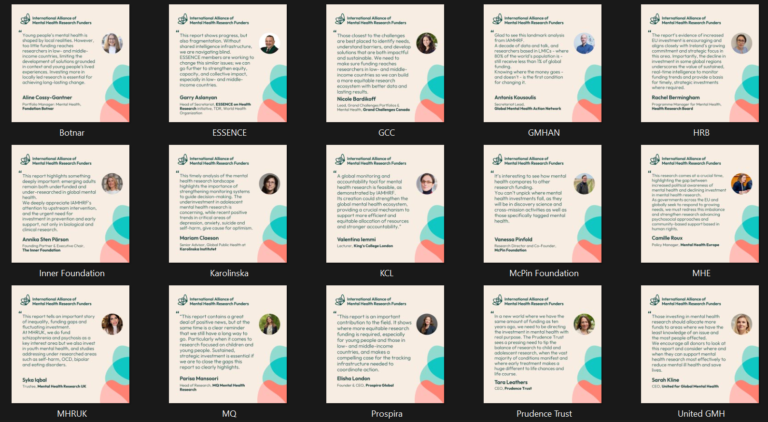
Leaders and experts at mental health organisations worldwide have reacted to the recent launch of IAMHRF’s report, Mental Health Research…
Read article
By Raliza Stoyanova, Executive Director, International Alliance of Mental Health Research Funders (IAMHRF), and Tom Kariuki, Chief Executive Officer, Science for Africa Foundation
A new open-data analysis of global mental health research funding, published recently by IAMHRF, covers a decade of investment from 2014 to 2023, drawing on around 110,000 grants from 40 funders. It tracks trends in funding by geography, condition, age group and research type. And it puts a number on something the sector has long suspected but not systematically quantified over time: less than 1% of the captured global mental health research funding reached researchers based in low- and middle-income countries (LMICs) over the period studied. That share did not improve between the first half of the decade and the second.
This figure, already small, masks further concentration. Over two-thirds of all LMIC-directed funding in the more recent period (2019–2023) went to just three countries. Funding to low-income countries fell by approximately 50% between the two halves of the decade, and funding to lower-middle-income countries fell by roughly 24%, while upper-middle-income countries saw an increase of nearly 80%.
The data suggest that within a limited and stagnant overall envelope, funding has shifted towards higher-resource LMIC settings, potentially reflecting funder preference for established research groups rather than deliberate investment in building new research capacity where needs are greatest.
This question matters to the Science for Africa Foundation (SFA) because it describes the structural environment in which African mental health researchers work. SFA’s flagship programme DELTAS Africa (including AMARI, dedicated to mental health research capacity building, and ALMA, whose neurosciences focus is understanding early-life brain development within the unique African context); the Being Initiative, a multi-continent effort focused on youth mental health stressors; and the Africa CDC Mental Health Leadership Programme, exist in part because the broader funding ecosystem has not yet provided the sustained, predictable support needed for African-led mental health science to grow on its own terms.
Africa has one of the largest mental health treatment gaps in the world, with most countries committing less than 1% of their health budgets to mental healthcare. Addressing that gap requires a research base that is led from within the continent, responsive to local priorities, and resourced accordingly.
The IAMHRF analysis cannot tell us everything. It captures only funders for whom structured grant data were openly available or directly provided, which means it likely under-represents LMIC-based funders, private philanthropy and smaller organisations. SFA’s own investments, for example, are not reflected in the dataset. The report is transparent about this limitation.
But the available data are nonetheless instructive, because they describe major public funder spending patterns that set the structural conditions for the field. When those funders collectively direct less than 1% of investment to LMIC-based researchers, the consequences are felt across the entire ecosystem, in training pipelines, institutional capacity, career pathways and the relevance of the resulting evidence base to the populations most affected.
This is not a new observation, but it is now better quantified and tracked over time. The 2020 IAMHRF report reached similar conclusions for the 2015–2019 period. In 2021, the accompanying Lancet Psychiatry paper described the pattern as “too little, too inequitable, too skewed”. What the current analysis adds is a decade-long trend: the inequity has persisted despite growing awareness, repeated political commitments, and real investment growth elsewhere in the system.
Separately, a recent commentary by the Calestous Juma Science Leadership Fellows, published in Nature Health, argues that overreliance on external funding has constrained African R&D priority-setting, and that domestic investment in research on the continent averaged just 0.33% of GDP in 2023. The structural under-investment documented in the IAMHRF data and the dependency dynamics described by the Fellows are two sides of the same problem.
We are not proposing a single solution. But we note that the report calls for a dedicated mental health research funding monitor, openly governed, continuously updated, and designed as a public good, as essential infrastructure for the field. From an African perspective, such infrastructure would need to do more than track where existing funding flows. It would need to make visible where funding does not flow, to track whether capacity-building commitments are translating into sustained institutional growth, and to support African research leaders in making the case for domestic and international investment based on shared evidence rather than fragmented and periodically assembled datasets.
The data in this report describe a problem that has been remarkably stable for a decade. Making it visible, consistently and in close to real time, would be a necessary, though not sufficient, step toward changing it.
______________
– Raliza Stoyanova is Executive Director of the International Alliance of Mental Health Research Funders (IAMHRF), and co-author of the report.
– Tom Kariuki is Chief Executive Officer of the Science for Africa Foundation.
– Read the full IAMHRF report and a commentary calling for shared infrastructure in The Lancet Psychiatry.
Leaders and experts at mental health organisations worldwide have reacted to the recent launch of IAMHRF’s report, Mental Health Research…
Read articleThe International Alliance of Mental Health Research Funders (IAMHRF) has published a new global analysis of mental health research funding…
Read articleOn 6 May 2026, the International Alliance of Mental Health Research Funders (IAMHRF) will publish a new global analysis of…
Read articleReflections from the International Alliance of Mental Health Research Funders The impact of cuts to care and research have been a source…
Read articleToo often, research produces interventions that are difficult to scale. This is frustrating for researchers, funders, and critically, those poised to…
Read articleThe 2025 United Nations (UN) General Assembly High-Level Meeting on Noncommunicable Diseases (NCDs) and Mental Health marked a historic moment…
Read articleBy James Sale, Deputy CEO, and Faith Nassozi, Communications Advisor, United for Global Mental Health An estimated 970 million people…
Read articleThe IAMHRF was invited to the Clinical Trials in Mental Health Symposium in Berlin, Germany. Our Programmes and Partnerships Director,…
Read articleA new expert commentary on the future of psychedelics as a treatment for mental health conditions has just been published…
Read articleOver the last week, we’ve been looking back at 2024 by celebrating the success stories of IAMHRF members. These fit…
Read article