IAMHRF Member News Roundup: Third Quarter of 2026
Highlights from across the Alliance Over the past few months, IAMHRF members have been building both the research base and the…
Read article
How many people experience problematic usage of the internet (PUI)? The answer is less straightforward than it sounds.
A new Lancet Psychiatry Commission draws on studies suggesting that PUI could affect more than one in ten people worldwide. But the estimates vary considerably. A review of studies conducted during the COVID-19 pandemic found a pooled prevalence as high as 25%, though applying a stricter threshold to the same evidence showed a much lower estimate of 7.9%.
The difference is important: it reflects how much estimates depend on the definitions, questionnaires and thresholds researchers use, as well as the people and places they study. The Commission concludes that the available evidence is not yet strong enough to establish a clear global trend over time.
PUI is an umbrella term covering a range of behaviours, from recognised disorders involving gambling or gaming, to problematic social media use, for which diagnostic standards are less established. The Commission is careful to distinguish ordinary online activity from behaviour associated with distress or harm. These are not all the same problem, and a high number of hours online does not, on its own, mean someone has a disorder.
For research funders, this uncertainty raises a practical question: what would help us build a more reliable picture of the problem, and of which responses make a difference?
The Commission identifies inconsistent definitions and measures as a major obstacle to progress. When studies ask different questions and apply different thresholds, it becomes difficult to compare their findings, combine evidence, or understand change over time.
IAMHRF has encountered a similar challenge in wider mental health research. In 2020, we helped bring funders, journals and measurement experts together through the Common Measures in Mental Health Science initiative. The idea is straightforward: encourage researchers to use a small set of shared measures alongside the tools they need for their own studies, so that results can be compared more easily. IAMHRF has recently called for an evaluation of how widely those measures have been adopted and whether they are producing data others can reuse.
PUI presents its own challenges. Measures need to distinguish problematic behaviour from ordinary, sometimes intensive, use of technology, while working across different ages, cultures, and online activities. The lesson from common measures is that agreement on what to measure, and how, takes intentionality, time and dedicated stewardship.
Prevalence is only part of the picture. Research also needs to establish how PUI affects people’s health, wellbeing, relationships, education, and working lives. The Commission explores potentially substantial health and economic costs, while acknowledging the uncertainty around current estimates.
PUI is not yet separately quantified in the Global Burden of Disease study. Without robust, comparable evidence of its consequences, it is hard to assess its impact alongside more established mental health conditions, or to understand which forms of PUI account for the greatest harm.
IAMHRF’s own work has shown the value of making fragmented information more useful for decisions. Our 2026 analysis mapped around 110,000 mental health research grants from 40 funders. It does not prescribe funding priorities, but provides a clearer view of where investment has gone and where gaps may remain.
Who participates in research matters just as much as what is measured. The Commission calls for more representative studies, particularly in low- and middle-income countries. Estimates of PUI sometimes appear higher in these settings, but differences in sampling and measurement make comparisons difficult.
Our funding analysis found that less than 1% of the mental health research funding captured between 2014 and 2023 went to researchers based in low- and middle-income countries. That is not a measure of funding for PUI specifically. It does, however, illustrate a broader imbalance that this emerging field should be mindful of.
Importantly, better evidence does not always require a new research programme. PUI overlaps with areas that many funders already support, including research into depression, anxiety, ADHD, and young people’s mental health.
Large longitudinal studies, including the US ABCD Study and All of Us research programme, already collect some information about screen time and related behaviours and the Commission sees opportunities to build on these cohorts. It also cautions that screen time is not the same as PUI. Researchers would need to consider how existing data could be used, where more specific measures are needed, and how to assess changes over time.
Lastly there is also an opportunity to learn from policy changes. Governments are taking different approaches to online safety, often before strong evidence about their effects is available. Independent evaluation, including research designed before measures take effect, could help establish what works and for whom.
The Commission covers a wide agenda, from definitions and epidemiology to prevention, treatment, and regulation. Its research recommendations touch on several challenges familiar to mental health funders: comparable measures, representative data, longitudinal studies, and independent evaluation.
The Commission offers much for mental health research funders to reflect on. IAMHRF’s Digital Working group will be following its recommendations with interest, particularly where they touch on challenges shared across the funding community.
Highlights from across the Alliance Over the past few months, IAMHRF members have been building both the research base and the…
Read articleWe’re commissioning an evaluation of our Common Measures in Mental Health Science Initiative, and looking for academic teams to lead…
Read articleHighlights from across the Alliance From new prizes and clinical trials strategies to fresh investment in youth mental health and open…
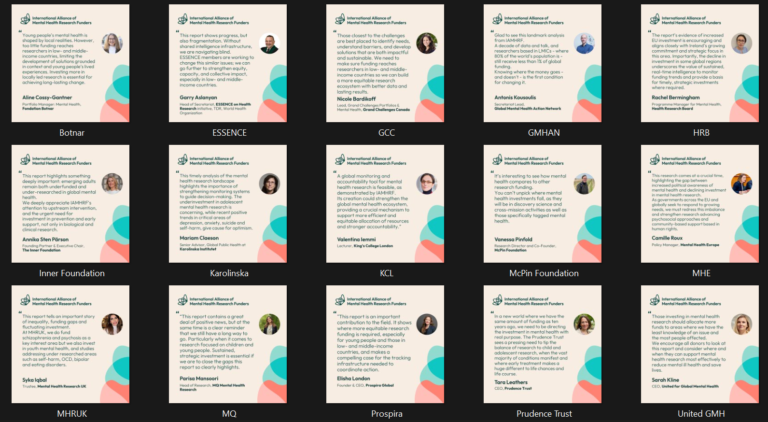
Read articleLeaders and experts at mental health organisations worldwide have reacted to the recent launch of IAMHRF’s report, Mental Health Research…
Read articleBy Raliza Stoyanova, Executive Director, International Alliance of Mental Health Research Funders (IAMHRF), and Tom Kariuki, Chief Executive Officer, Science…
Read articleThe International Alliance of Mental Health Research Funders (IAMHRF) has published a new global analysis of mental health research funding…
Read articleOn 6 May 2026, the International Alliance of Mental Health Research Funders (IAMHRF) will publish a new global analysis of…
Read articleHighlights from across the Alliance From new investments in research participation to fresh evidence on youth mental health and innovative ways…
Read articleReflections from the International Alliance of Mental Health Research Funders The impact of cuts to care and research have been a source…
Read articleExplore some of what our members achieved in 2025 Overview Browse through the success stories below and spread the word…
Read articleFrom 12–14 November 2025, IAMHRF brought together around 40 delegates in Cape Town, South Africa, for an in-person meeting focused…
Read articleToo often, research produces interventions that are difficult to scale. This is frustrating for researchers, funders, and critically, those poised to…
Read articleThe 2025 United Nations (UN) General Assembly High-Level Meeting on Noncommunicable Diseases (NCDs) and Mental Health marked a historic moment…
Read articleBy James Sale, Deputy CEO, and Faith Nassozi, Communications Advisor, United for Global Mental Health An estimated 970 million people…
Read articleOur new website features an innovative hub: a curated, daily updated portal for mental health research funding opportunities. This global resource —…
Read articleThe IAMHRF was invited to the Clinical Trials in Mental Health Symposium in Berlin, Germany. Our Programmes and Partnerships Director,…
Read articleThe International Alliance of Mental Health Research Funders (IAMHRF) brought vital energy and insight to the International BNA 2025 Festival…
Read articleThe National Mental Health Research Strategy is a comprehensive framework to guide and advance mental health research in Ireland. It…
Read articleA new expert commentary on the future of psychedelics as a treatment for mental health conditions has just been published…
Read articleMQ mental health research* launched a campaign during Mental Health Awareness Week inviting communities to help fund the next wave…
Read articleThe Being Initiative’s new report, Youth Voices: A Guide to Meaningful Youth Engagement in Mental Health Funding, makes one thing…
Read articleAs part of its Evidence for Policy theme, the Health Research Board (HRB)* launched a new podcast series exploring the…
Read articleIAMHRF Members represent the world’s largest funders of mental health research. They are government funders, philanthropic foundations, and fundraising charities…
Read articleOver the last week, we’ve been looking back at 2024 by celebrating the success stories of IAMHRF members. These fit…
Read articleSince its establishment by Congress in 1949, NIMH has played a pivotal role in driving mental health research, fostering innovation,…
Read articleSince 2011, Grand Challenges Canada has invested in 132 mental health projects across 42 low- and middle-income countries. In November 2024, GCC convened…
Read articleThe Mariwala Health Initiative (MHI) continues to pave the way for a more inclusive and supportive mental health system. This…
Read articleThe research led by ZonMw’s Action Program “Grip on Misunderstanding” initiative fosters collaboration between police, municipalities and organisations that offer…
Read articleIn today’s digital age, social media is deeply ingrained in our daily lives and provides a space where people can…
Read articleIn October 2024, the results of the Wellcome-funded AVATAR2 trial were published in Nature Medicine. In AVATAR therapy, a person who…
Read articleThe Medical Research Council (MRC), on behalf of UK Research and Innovation (UKRI), has established a £22.5 million Mental Health Research…
Read articleThe Being Initiative —a partnership that includes IAMHRF members and partners including Fondation Botnar, GCC, UNITED, and Orygen — published a new Public…
Read articleUSAID has long supported initiatives that increase access to mental health services. The Agency now elevates this commitment with the…
Read articleWhen organisations unite to tackle pressing challenges, meaningful progress can be achieved. The Canadian Institutes of Health Research (CIHR) and the Graham Boeckh Foundation…
Read articleIreland’s National Mental Health Research Strategy, led by the Health Research Board (HRB), is a groundbreaking milestone in mental health research,…
Read article